Data reports
The 10 Most Underrated Housing Markets in America (2026)
The strongest markets in the country are rarely the ones in the headlines. Here is what the data says — ranked, with the method behind it.
Part of the State Of The Market series →

Ask most people for the country's best housing markets and you'll get the same dozen names: Austin, Miami, Phoenix, Nashville. Those are the markets with the most attention. Attention and fundamentals are not the same thing.
LocalAlpha scores roughly 900 metros on a single 0–100 number, the Alpha Score, built from five forces: price momentum, inventory health, affordability, economic strength, and rental yield. When you rank by that score instead of by buzz, the list looks different. The strongest markets are mostly mid-size metros doing the unglamorous things well: enough inventory to transact, prices in line with local incomes, and steady jobs.
The 10 highest-scoring metros right now
The table below is a snapshot, dated where it stands, so the ranking you read is the ranking this piece was written about. Every metro shown clears a population floor, which keeps out the micro-markets that score well on thin data.
| # | Market | Alpha Score | Temperature |
|---|---|---|---|
| 1 | Jefferson City, MO metro areametro | 70 | Seller's |
| 2 | Erie, PA metro areametro | 68 | Seller's |
| 3 | Davenport, IA metro areametro | 67 | Seller's |
| 4 | Abilene, TX metro areametro | 67 | Seller's |
| 5 | Cedar Rapids, IA metro areametro | 67 | Seller's |
| 6 | Peoria, IL metro areametro | 66 | Seller's |
| 7 | Janesville, WI metro areametro | 66 | Seller's |
| 8 | Lake Charles, LA metro areametro | 66 | Seller's |
| 9 | Oshkosh, WI metro areametro | 65 | Seller's |
| 10 | Iowa City, IA metro areametro | 64 | Seller's |
Data as of Aug 2026
Ranked by overall Alpha Score (0–100). Population floor applied so micro-metros are excluded. Click any market for its full breakdown.
Jefferson City tops it at 70, and the spread from first to tenth is six points, which is narrow enough that the order matters less than the membership. What these ten share is easier to see dimension by dimension than market by market.
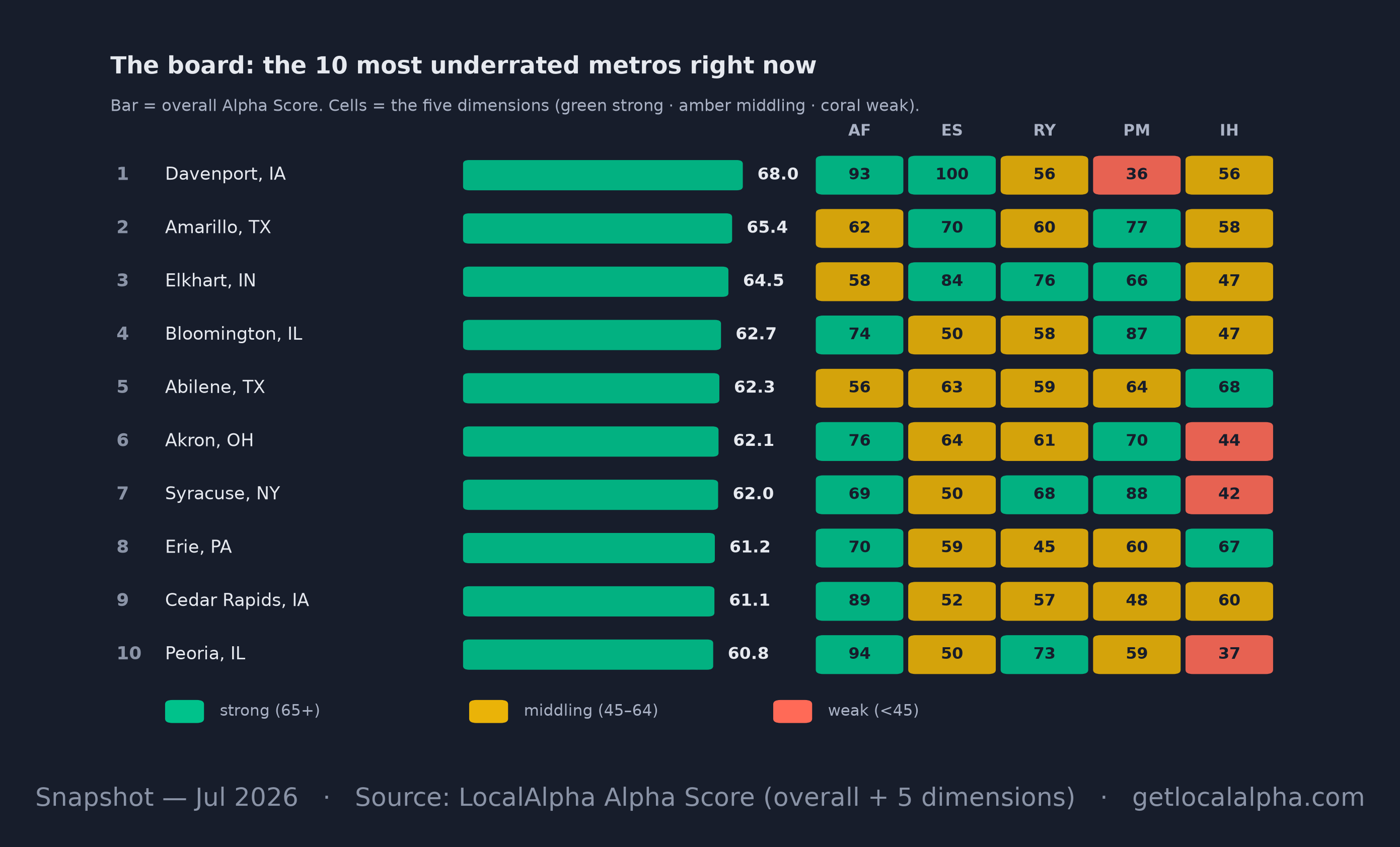
The board: the same ten metros the table above ranks, with each market’s five dimensions laid out as heat cells. Price momentum and rental yield run green down the board; inventory health is the only dimension without a single green cell. A snapshot — pull up any market for the live read.
ExpandRead down the columns rather than across the rows. The price-momentum and rental-yield cells carry the colour; inventory health is the one column with no green cell on it at all. None of these markets is here because it is tight.
What "underrated" actually means in the data
"Underrated" here is a specific shape in the numbers: a high Alpha Score paired with low national attention. Three dimensions do most of the lifting at the top of this list, and none of them makes magazine covers.
The first is affordability, the ratio of home prices to local incomes. A market where a normal local salary can still buy a normal local house has room to keep working. The second is rental yield — the rent these places command against what they cost to buy, which opens the second-widest gap between these ten and the rest of the field. The third is inventory health — not because these markets are tight, but because they are not starved either: at 57 against 37 for the rest of the field it is the third-widest gap, while remaining the lowest score these ten carry. Economic strength is steady here too, but it is the narrowest separator of the five (63 against 50), so it is what these markets share with the field rather than what sets them apart. Together they describe a market where a normal local salary buys a normal local house and the rent covers a real share of it. That combination is quietly valuable, and it almost never trends on social media.
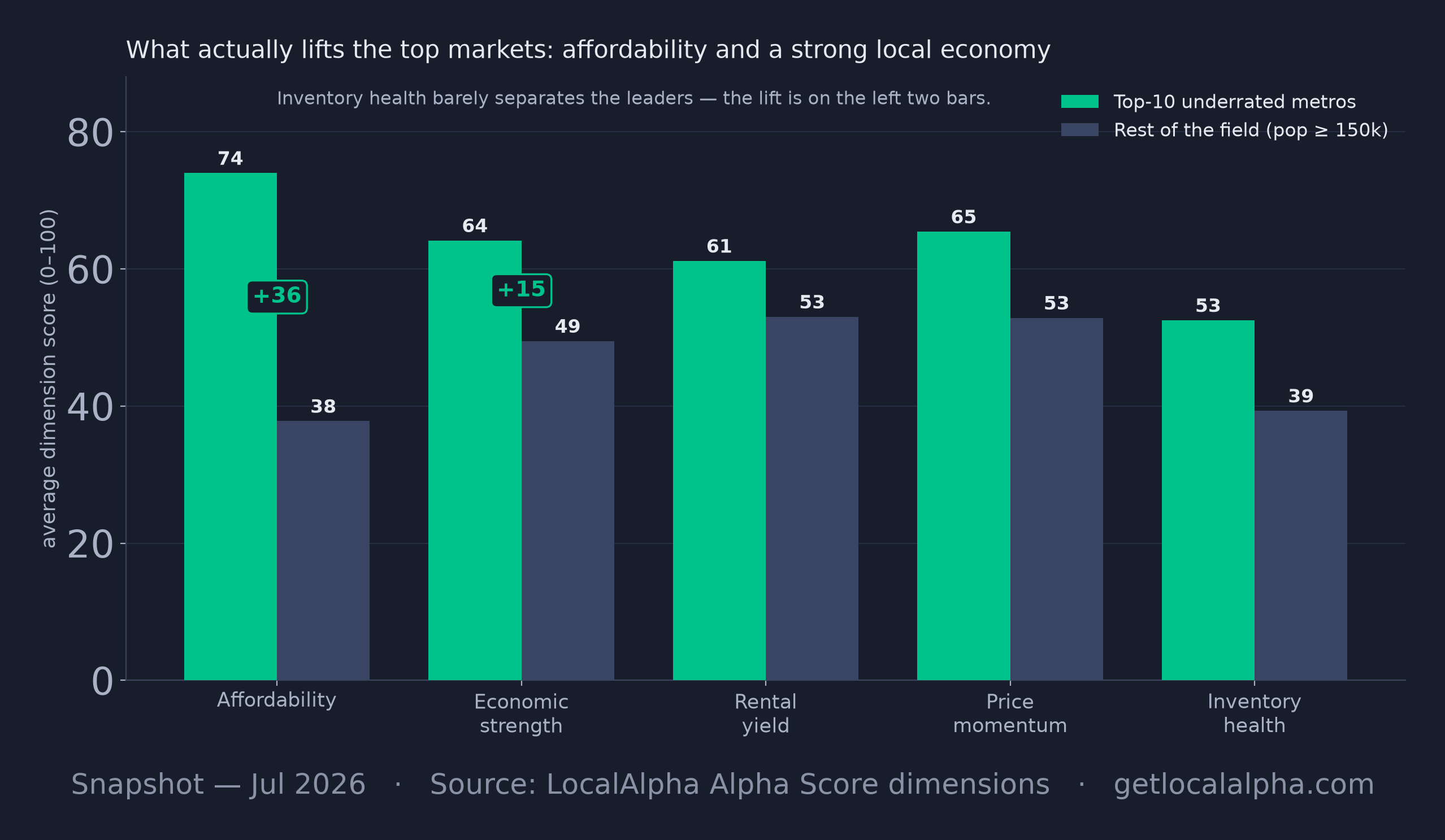
Average dimension scores, top-10 underrated metros vs. every other metro above the population floor. Affordability (+34) and rental yield (+27) are where the leaders separate most, with inventory health (+20), price momentum (+18) and economic strength (+13) behind them. Snapshot of current Alpha Score dimensions.
ExpandThat is the whole finding in five pairs of bars. Affordability runs 72 against 38 for the rest of the field, a 34-point gap, and rental yield runs 71 against 44. Economic strength adds 63 against 50. Inventory health, the dimension that makes a market feel hot, is the lowest score these ten carry at 57, only modestly above the neutral midpoint. They are underrated because they are affordable places where the rent works and the payrolls are real, not because there is nothing to buy.
Cheap with a job attached is the whole list.
Why the biggest metros rarely make the list
Notice who's missing: the marquee names. That is the model working. The largest, most famous metros usually pay for their size in affordability. Prices have run well past local incomes, so the affordability dimension drags the composite down. (Some Sunbelt boomtowns — Austin among them — miss for a different reason: prices that have stopped rising and inventory that has loosened, not affordability.) A market can be a great place to live and a mediocre place to transact right now. The Alpha Score measures the second thing.
Key takeaways
- A high Alpha Score is a read on current conditions, not a price prediction — it tells you where the fundamentals are strongest today.
- Affordability does a lot of the work: metros where prices stay close to local incomes tend to outscore expensive coastal markets.
- The biggest metros rarely top the list. The Alpha Score rewards balance, and the largest markets usually pay for their size in affordability.
- Every market on the list links to its full five-dimension breakdown, so you can see exactly why it ranks where it does.
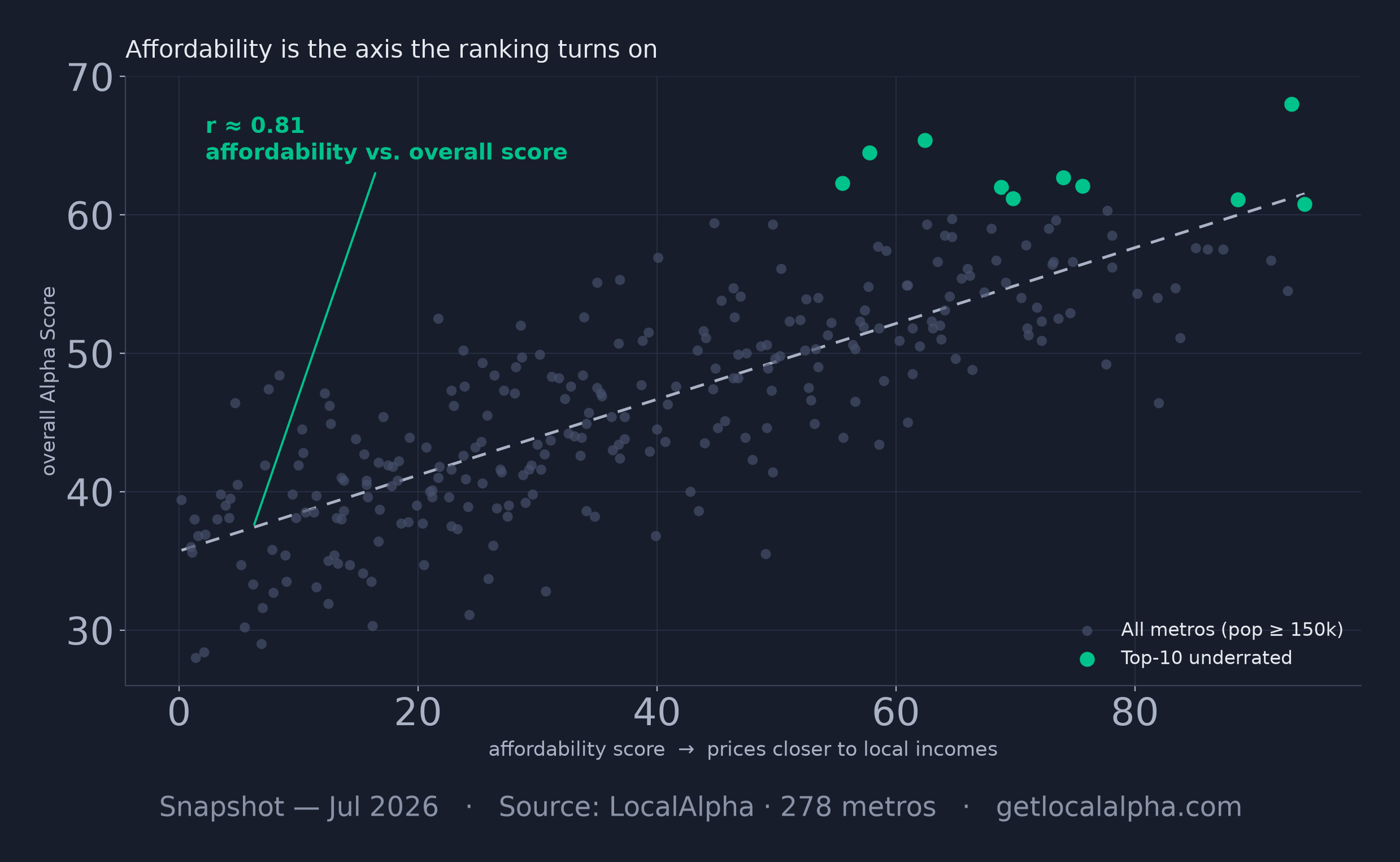
Across 308 metros the relationship is strong, about 0.76, so affordability explains most of where a market lands. Two details complicate it. The ten sit above the trend line rather than on it, meaning they beat what their affordability alone would predict. And several metros further right, cheaper still, score lower, so cheap on its own does not get you here.
How we rank markets
The Alpha Score is a weighted blend of up to five dimensions: Inventory Health (25%), Price Momentum (20%), Affordability (20%), Economic Strength (20%), and Rental Yield (15%) — where a dimension we cannot measure for a market is left out and the remaining weights re-scaled, and where fewer than three measurable dimensions means we publish no score at all — each ranked against peer markets of the same type. To keep this list honest, we apply a population floor so a tiny metro that scores high on thin data can't crowd out real markets. The full weighting is set out at the foot of this piece.
We'll keep watching this ranking as new data lands. The interesting question isn't who's on top this month, it's which markets are climbing.
Want to see how your own market scores against this list?
Explore the map
P.S. The six-point spread from first to tenth is thin enough that I would not read the order too hard. If a market I liked sat at eleven I would still look at it.
Frequently asked questions
Are these good markets to invest in?
A high Alpha Score means strong current conditions, not a guaranteed return. It is a starting point for research, not a buy signal. Use it to find markets worth a closer look, then dig into the specific deal, neighborhood, and your own strategy.
Why isn't a big, well-known city on the list?
The largest coastal metros usually score lowest on affordability — prices have outrun local incomes by so much that the dimension floors near zero. Sunbelt boom metros can miss for a different reason: cooling price momentum and loosening inventory rather than affordability. The ranking rewards balanced fundamentals, not size or fame.
How often does this ranking update?
The table is a snapshot carrying the as-of date shown above it, not a live read — so the ranking you see is the one this piece was written about. The underlying Alpha Scores do recompute as new data lands (Redfin as its monthly release is brought in; government series monthly to annually), so a live look a month from now may order these markets differently.
What does the population floor exclude?
It filters out micro-metros that can post high scores on very thin data. The goal is a list of recognizable, real markets — not statistical noise from a town with a handful of sales.
Does a high Alpha Score mean prices will go up?
No. The score reads current conditions, not the future. Strong fundamentals make a market more resilient, but the score is not a price forecast.
Methodology: markets are ranked on the overall Alpha Score, weighted across five dimensions as set out on the methodology page, restricted to metros with at least 150,000 people so thin-data micro-markets cannot place. Figures are per Redfin (prices, supply), Census ACS (income, rent) and BLS (jobs, wages). The table and every chart are snapshots as of the date each one states, not live reads.
Last updated Sep 11, 2026